Showing posts with label MASTECTOMY. Show all posts

Saturday, August 9, 2014

Choosing Not to Have Reconstruction — Are You the Only One?

By  on July 31st, 2014Categories: Treatment & Side Effects
If you’re facing a mastectomy, you may be surprised to find that virtually everyone expects you to have reconstruction. Your doctors, your friends, and even your family may believe that without reconstruction you won’t be happy and you won’t feel whole or feminine. But what if you don’t share these concerns? What if you don’t think reconstruction is right for you?
Perhaps you want to avoid extra surgery and the added risk of complications and chronic pain, or maybe you simply prefer no breasts to reconstructed ones. Whatever your reason for choosing not to have reconstruction, it can be disconcerting if your doctors and the people who care about you don’t understand your decision. You may feel isolated and even start to doubt your own wishes. But let me assure you — you’re not alone!
Many women who visit my website, BreastFree.org, tell me how relieved they are to discover a community of women who agree that non-reconstruction is the best choice for them. Sometimes, these women have struggled to find a surgeon who will support their wish not to have reconstruction. In a couple of worst-case scenarios, I’ve heard from women whose doctors insisted that they see a psychologist before they would agree to perform a mastectomy without reconstruction.
I’ve long wondered why so many doctors believe their patients would be better off with reconstruction than without. It’s certainly not for medical reasons, since once a mastectomy is deemed necessary, simply removing the breast is the least invasive option. And detecting a recurrence after a simple mastectomy is at least as easy as after reconstructive surgery.
Perhaps some physicians believe that they or their loved ones would feel disfigured without reconstruction, so therefore assume their patients would likewise feel disfigured. Maybe friends and family have similar concerns. While well-meaning, these assumptions can put you on the defensive and make you feel that you have to justify your decision not to reconstruct. This is why it can be so helpful to connect with other women who have never regarded their mastectomies as disfiguring.
When performed by a skilled surgeon, a mastectomy without reconstruction can leave your chest looking smooth and flat, with a thin incision that will become almost invisible. If you want the appearance of breasts, you can always wear breast forms. I like to think of breast forms as external prostheses, whereas women who choose reconstruction have internal prostheses. Some women don’t feel the need to use breast forms at all, preferring to go flat. Far from being viewed as disfigured, women who go flat usually find that few people even notice.
Though your friends and members of your family may advocate reconstruction, they may be unaware of its challenges. One of my friends opined that having implant reconstruction would be just like having breast augmentation. Only when I explained that after a mastectomy a tissue expander must be inserted under the pectoral muscle and gradually filled did she understand the difference. Another friend had heard about tissue flap reconstruction. Once I described the lengthy surgery and long time under anesthesia required, as well as the additional scars, she better understood my reluctance.
While most women who choose reconstruction do very well and are happy with their decision, I sometimes hear from women whose implant reconstruction has led to chronic pain. They tend to feel isolated and depressed about their situation and are relieved to learn that other women have experienced similar issues and have had their implants removed, in most cases alleviating the pain.
The women who visit BreastFree.org appreciate the personal stories, photographs, and advice they find there, all of which help them feel part of a community. But many also want a place where they can communicate directly with other women. For that, there’s no better resource than the Discussion Boards right here at Breastcancer.org. The Boards feature a forum specifically intended for women who choose not to have reconstruction — Living Without Reconstruction After a Mastectomy. Women often continue to participate in this forum for years after their diagnosis, helping newcomers and sharing experiences.
Have you faced a decision about whether or not to have reconstruction? If so, did you find support for your wishes?
After being diagnosed with two primary breast cancers in three years, Barbara learned she needed a mastectomy. She opted not to have reconstruction and subsequently founded BreastFree.org, a nonprofit website that presents non-reconstruction as a positive alternative to reconstruction. In addition to her work at BreastFree.org, Barbara writes essays on a wide variety of subjects. Many of them can be found on her personal blog, What, Me Worry?

Tuesday, May 14, 2013


OP-ED CONTRIBUTOR

My Medical Choice

  • FACEBOOK
  • TWITTER
  • GOOGLE+
  • SAVE
  • E-MAIL
  • SHARE
  • PRINT
  • REPRINTS
LOS ANGELES
Loren Capelli
Opinion Twitter Logo.

Connect With Us on Twitter

For Op-Ed, follow@nytopinion and to hear from the editorial page editor, Andrew Rosenthal, follow@andyrNYT.

Readers’ Comments

MY MOTHER fought cancer for almost a decade and died at 56. She held out long enough to meet the first of her grandchildren and to hold them in her arms. But my other children will never have the chance to know her and experience how loving and gracious she was.
We often speak of “Mommy’s mommy,” and I find myself trying to explain the illness that took her away from us. They have asked if the same could happen to me. I have always told them not to worry, but the truth is I carry a “faulty” gene, BRCA1, which sharply increases my risk of developing breast cancer andovarian cancer.
My doctors estimated that I had an 87 percent risk of breast cancer and a 50 percent risk of ovarian cancer, although the risk is different in the case of each woman.
Only a fraction of breast cancers result from an inherited gene mutation. Those with a defect in BRCA1 have a 65 percent risk of getting it, on average.
Once I knew that this was my reality, I decided to be proactive and to minimize the risk as much I could. I made a decision to have a preventive double mastectomy. I started with the breasts, as my risk of breast cancer is higher than my risk of ovarian cancer, and the surgery is more complex.
On April 27, I finished the three months of medical procedures that the mastectomies involved. During that time I have been able to keep this private and to carry on with my work.
But I am writing about it now because I hope that other women can benefit from my experience. Cancer is still a word that strikes fear into people’s hearts, producing a deep sense of powerlessness. But today it is possible to find out through a blood test whether you are highly susceptible to breast and ovarian cancer, and then take action.
My own process began on Feb. 2 with a procedure known as a “nipple delay,” which rules out disease in the breast ducts behind the nipple and draws extra blood flow to the area. This causes some pain and a lot of bruising, but it increases the chance of saving the nipple.
Two weeks later I had the major surgery, where the breast tissue is removed and temporary fillers are put in place. The operation can take eight hours. You wake up with drain tubes and expanders in your breasts. It does feel like a scene out of a science-fiction film. But days after surgery you can be back to a normal life.
Nine weeks later, the final surgery is completed with the reconstruction of the breasts with an implant. There have been many advances in this procedure in the last few years, and the results can be beautiful.
I wanted to write this to tell other women that the decision to have a mastectomy was not easy. But it is one I am very happy that I made. My chances of developing breast cancer have dropped from 87 percent to under 5 percent. I can tell my children that they don’t need to fear they will lose me to breast cancer.
It is reassuring that they see nothing that makes them uncomfortable. They can see my small scars and that’s it. Everything else is just Mommy, the same as she always was. And they know that I love them and will do anything to be with them as long as I can. On a personal note, I do not feel any less of a woman. I feel empowered that I made a strong choice that in no way diminishes my femininity.
I am fortunate to have a partner, Brad Pitt, who is so loving and supportive. So to anyone who has a wife or girlfriend going through this, know that you are a very important part of the transition. Brad was at the Pink Lotus Breast Center, where I was treated, for every minute of the surgeries. We managed to find moments to laugh together. We knew this was the right thing to do for our family and that it would bring us closer. And it has.
For any woman reading this, I hope it helps you to know you have options. I want to encourage every woman, especially if you have a family history of breast or ovarian cancer, to seek out the information and medical experts who can help you through this aspect of your life, and to make your own informed choices.
I acknowledge that there are many wonderful holistic doctors working on alternatives to surgery. My own regimen will be posted in due course on the Web site of the Pink Lotus Breast Center. I hope that this will be helpful to other women.
Breast cancer alone kills some 458,000 people each year, according to the World Health Organization, mainly in low- and middle-income countries. It has got to be a priority to ensure that more women can access gene testing and lifesaving preventive treatment, whatever their means and background, wherever they live. The cost of testing for BRCA1 and BRCA2, at more than $3,000 in the United States, remains an obstacle for many women.
I choose not to keep my story private because there are many women who do not know that they might be living under the shadow of cancer. It is my hope that they, too, will be able to get gene tested, and that if they have a high risk they, too, will know that they have strong options.
Life comes with many challenges. The ones that should not scare us are the ones we can take on and take control of.

Monday, February 25, 2013

Navigating Cancer


Mastectomy

Hello, my name is Rose and I’m 42 years old, I have had a Mastectomy over a year ago and I was thinking of getting reconstruction. I’m very nervous about going through another surgery but is it worth it? I’m wondering how long is recovery and if it’s very painful?
  • Post #1
  • Tue Jan 29, 2013
Hi Rose, I am 40 years old and had a Mastectomy April 2012. I am also thinking of getting reconstruction soon. I have the same anxiety about going through another surgery. I was told I would have the tissue expanders put in first and once I reach the desired size, another surgery to replace the expanders with the implant.
  • Post #2
  • Tue Jan 29, 2013
Hello Ellvenus, I have not had a consultation yet so I wanted to get some feedback on which surgery would be the best or how long recovery would be? Have they spoke to you about how long recovery would be? Or how painful it might be? I know its another major surgery.
  • Post #3
  • Tue Jan 29, 2013
Sorry, no. I have not had consultation yet either.
  • Post #4
  • Wed Jan 30, 2013
Oh o.k. thanks good luck with everything.
  • Post #5
  • Wed Jan 30, 2013
I have had the reconstructive surgery. They took the skin needed from my stomach. Surgery/recovery was about a week due to the tummy tuck. Please interview MANY plastic surgeons. You only get one shot at the apple apparently. I got a bad dr and no one else would “fix” his work. I’m not talking cosmetically. Everything he did had to be removed. One expander migrated down under my arm pit! I finally found a wonderful dr that does repair other drs mistakes. Don’t expect to look like you did before.
  • Post #6
  • Sat Feb 2, 2013
There’s a lot involved with reconstructive surgeries following mastectomies and it is very important to consult with several " board certified" plastic and reconstructive surgeons! I’ve been in the field as an RN for over 30 years and have seen a lot of surgeries. Often the best plans and surgeries need to be redone or revised and not necessarily due to anyone’s fault. If you don’t have surgeons in your area you might look into some larger medical centers where they have teams of surgeons who do these reconstructions on a regular basis. I’m almost 1 year post mastectomy for stage lll A metastatic cancer and chose to do all my chemo and radiation first so my body wouldn’t have any “foreign” materials to also contend with during the treatments. By waiting, I also have come to terms with my different body image and can now appreciate not needing a prosthesis to fill out my bra in the future. I know it’ll never look the same but I know I’ll look better and the added bonus is the lift on the opposite side to rejuvenate my figure. I’ve consulted with several plastic surgeons and weighed the pros and cons of their recommendations to make my final decision. You need to feel comfortable with the surgeon and be able to discuss your wants and fears with them. Getting to know as much detail as possible about the various phases of your treatment will also help you to feel more in tuned with the entire process so you have a favorable outcome. I’m planning my surgery for later this year and though a year ago it would have been the last thing I’d plan on, I’m looking forward to the procedure. Hope this helps.
  • Post #7
  • Sat Feb 2, 2013
I had a mastectomy over 10 years ago at age 39. I did not have reconstruction until about a year and a half later to give myself time to recover and my skin to heal after chemo and radiation. Also, my oncologist told me that my cancer had a very high rate of return and I had several lymph nodes involved. Therefore, I decided to have the other breast removed as well. I did it all at the same time. It was more painful than the first surgery and I had four drains. I think I spent two nights in the hospital, maybe three? I don’t recall exactly how long it was to recover from surgery but don’t think it was any longer than the first. I interviewed many plastic surgeons and women about their experience before choosing. For me, saline implants seemed the best option because I am too thin to use my stomach. One doctor tried to convince me to do a Lattisimus dorsi transfer but I did not want another scar or to lose muscle function. The first few injections of 60 cc were fine but then it was very painful. So the next time I was prepared and I took pain meds and told the MD to use fewer ccs and it made a huge difference. This is getting long so I will leave off other details but feel free to ask specific questions. I am very glad that I had it done! Look great in clothes and don’t have to wear a bra :-) I agree that you don’t look the same undressed but neither did I before. I like being symmetrical and not worrying about a prosthesis. Btw it only hurt on the cancer side, from the radiation. My friend who didn’t have radiation did not complain at all. Blessings to you as you make you decision.
  • Post #8
  • Sat Feb 2, 2013
On January 22, 2013 I had a bilateral mastectomy I left from the hospital with four drains and expanders once I got home I decided not to takse anymore Percocet ive been just taking 2 of Tylenol 500 pain wise a lot of discomfort on my back ive been sleeping on a lift recliner which has helped me a lot pain so far hasnt been something major that I haven’t been able to tolerate I always find the strength knowing God is with me we have to face our fears
  • Post #9
  • Sat Feb 2, 2013
I had the mastectomy and the transflap reconstruction all at one time. Very painful! My core is weak. It has been 3 years ago. Do not expect that it’ll look like before cancer or to have the sensation. But I do believe it is better this than to mess with prosthetic breasts. I’m 44 years, breasts are still important, if I was way older I probably wouldn’t get reconstruction. I had great surgeons that talked me through the processe

Saturday, February 23, 2013

Who's Fueling the American Fake Boob Trend? In Part, Breast Cancer Survivors.


Who's Fueling the American Fake Boob Trend? In Part, Breast Cancer Survivors.

136876622
Not just for Playmates anymore
Photo by Miguel Medina/AFP/Getty Images
Amanda M., I was also fascinated to see that breast augmentations have tripled in the United States in the past 15 years. According to a survey by the American Society for Aesthetic Plastic Surgery, American surgeons performed 101,176 breast augmentations in 1997, and 316,848 in 2011. But the trend doesn’t just speak to our country's love affair with “big, fake boobs.” There’s a silver lining to why American women are rocking more breast implants these days: The option is now a lot more accessible for breast cancer survivors.
In 1998, the Women's Health and Cancer Rights Act began requiring health insurance plans that cover mastectomies to also foot the bill for reconstructive surgeries, many of which involve implanting the same saline and silicone prostheses favored by The Girls Next Door. From 1998 to 2007, post-mastectomy reconstructions doubled.

How do these reconstruction rates compare to those of purely aesthetic breast implant procedures? It's hard to know. Those annual aesthetic surgery reports rely on voluntary surveys administered to plastic surgeons around the world, and many of those doctors are performing reconstructive procedures alongside purely elective ones. The Surveillance, Epidemiology and End Results (SEER) database, which tracks American mastectomy patients, does keep tabs on some reconstruction procedures. But it follows just a fraction of all the women who receive mastectomies in the United States every year, and only records reconstructions completed within four months of the breast removal. Some breast cancer survivors need to wait to complete radiation and chemotherapy treatments before reconstruction is an option. Down the line, the American Cancer Society estimates that as many as half of women who receive implants as a part of their reconstruction will need to undergo an additional surgery to replace them within the decade. And many women who have a breast reconstructed after a single mastectomy will opt to perform an aesthetic lift, reduction, or augmentation on the opposite breast as well. While rates of aesthetic breast augmentations appear to be soaring, it’s likely that reconstruction rates are underreported.
What is clear is that reconstructive patients now make up a significant portion of women with “fake breasts” in the United States. The American Society of Plastic Surgeons, which does record breast surgeries coded as reconstructive, tallied up 96,277 breast reconstructions in 2011. I have a call out to ASAPS for some better clarity on the breakdown of its numbers, and will update if the organization responds. But even if we assume that ASAPS’s big, bad 316,848 boob jobs don’t include any reconstructive patients, that still means that about a quarter of women who receive new breasts every year are doing so in the course of their medical recovery.
Reconstruction isn't for everyone—most women who undergo a mastectomy still opt out. And in the case of underinsured, low-income, and rural breast cancer patients, it remains an inaccessible option. But studies have indicated that the procedure's rise has helped many women improve feelings of self-worth, body image, and “social and occupational functioning” that have been compromised by a mastectomy. And according to Dr. Leigh Neumayer, a professor of surgery at the University of Utah, many breast cancer patients take cues on reconstruction from survivors in their communities. As breast implants become normalized for cancer survivors, more women will have access to—and be thankful for—the choice. It’s just another reason why we should reconsider the stigma against all-American fake boobs. In this case, I, for one, welcome our silicone overlords.

Tuesday, November 29, 2011

My mom just got diagnosed - I am so scared. She sees the surgeon on Monday to schedule a bilateral mastecomy. What should I expect and what can I do?

Asked by 
 Family Member or Loved One 11 days ago

Bottom of Form

·         
Stage 3C Patient
Hi Kim, I'm sorry to hear about your Mom. It's wonderful that she has a caring daughter like you! :). I just had my bilateral mastectomy on Oct. 24th and am still recovering. Usually the hospital stay is just overnight. She'll have 2 or more drains that will need to be emptied periodically and the fluid measured when she returns home. Her dr and/or nurses should explain the correct way to do this. You could help her with this. She won't be able to lift anything over 10 lbs or drive for a few weeks. Also taking a bath with the drains can be a little tricky at first and might need some help. I took a long shoestring and tied the drains up ( like a necklace). This kept my incisions dry and drains out of the way so I could bathe. If she has a recliner ....that would be a great help. She won't be able to lie on her side to sleep for awhile and my recliner was a lifesaver for me as far as being comfortable! If not....then several comfy pillows so she can prop herself up would be good as well. All those things will help her as well as helping her with meals. Emotionally it's difficult losing your breasts. It will be an adjustment for her. Give her lots of TLC. :). I'll say a prayer for your Mom and best wishes on Monday!!

Monday, October 24, 2011


The decision to have a mastectomy (a response to Dr. Susan Love’s post)

October 24th, 2011 § 6 comments
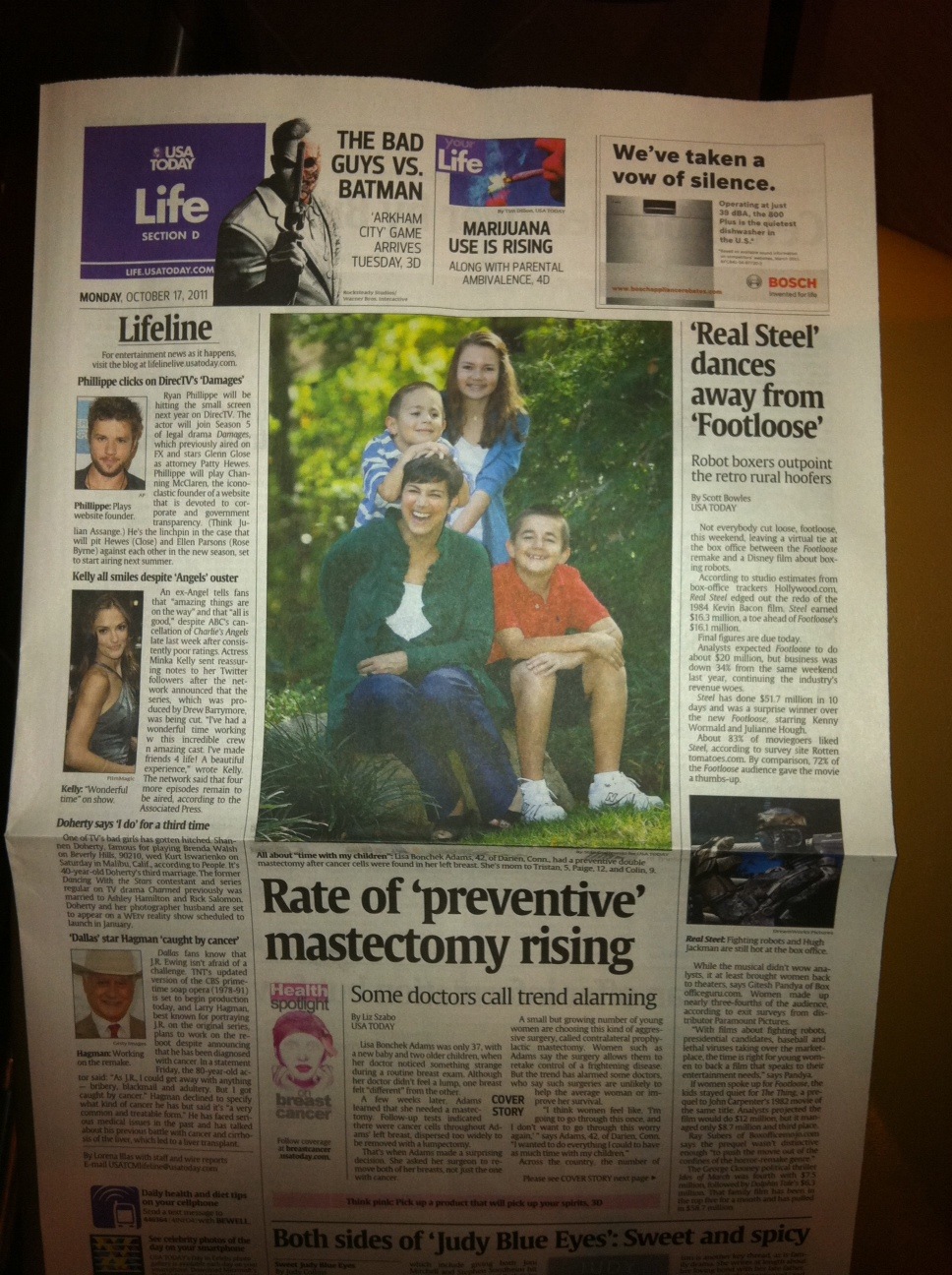
Last week I was featured in an article by Liz Szabo in USA Today. You can find the story here. It was so much fun to see how many people saw the piece and for the kids to see themselves in a national newspaper.
The decision to have a mastectomy is not an easy one. Many men and women with breast cancer are thankful that their cancer is in a location where the tumor and surrounding tissue can be removed. When faced with cancer the reflexive reaction may be “just get the cancer out.” Statistics on recurrence and mortality rates with certain treatment options are handed over; a new language is learned, risks are assessed. How much risk is acceptable?
Dr. Susan Love, noted breast surgeon, argued in a blogpost recently that decisions by breast cancer patients to have mastectomies constitute “wishful thinking” on their part.
I agree with a few of the points Dr. Love makes, first and foremost that a mastectomy is not equivalent with a “cure” and that it does not ensure cancer will not recur. The problem is that her post really makes it sound like she is arguing with the decision.
In my case, I needed to have one breast removed; I opted to have the other removed as well.
Let me be clear: I had no delusions that a contralateral mastectomy was going to save my life or even prevent me from having a recurrence.1 I knew I could not control if my cancer would return. What I knew is that I could control how I treated my cancer, how I managed it, how I lived with it/after it. I knew there would be choices to be made. I knew cancer would not be a “once and done” thing for me. Survivorship means living with the ramifications of the disease, long after hair has grown back in.
I also very much agree with Dr. Love’s critique of food and eating particular items to prevent breast cancer or keep it from recurring. Dr. Love writes:
Finally, there is the wishful thinking about diet! The headlines scream that if you eat blueberries or drink red wine or don’t drink red wine you will not get breast cancer. We all want to believe this magic!
In reality, these findings come from observational studies, which show you a correlation, but cannot prove cause and effect. If you knew that all drug addicts drank milk as babies, would you really think that drinking milk as a baby could make you a drug addict? Of course not! That’s a correlation. It’s not cause and effect.  Exercise and maintaining a healthy weight have been shown to reduce risk, but what you eat seems less critical.
I agree that it may be tempting to cling to food as protective and/or curative. After all, when cancer takes so much from us, there is a desire to control the factors that we can — including what we eat and drink. I can’t tell you the number of women I know whom, at the time of diagnosis or the completion of treatment, decide they will eat “clean” or “healthy” and are right back in their old ways within months. During the acute phases of surgeries, chemotherapy, and/or radiation there can be a desire to take fear and channel it. By controlling what we ingest, we must be controlling what our body does and what happens to cells, right? Dr. Love reports that this is not as strong a case as one might think.
In my own opinion, if what we ate and drank were that instrumental in determining who got cancer and who had a recurrence, we’d have a cure by now. This is not to say that we aren’t learning more about risk factors and how certain foods can affect likelihoods of getting certain cancers. But for now, we do not have the scientific evidence to support such cut and dry statments about causality with breast cancer.
She shows little insight in her post into the mental reasoning that women make when deciding their treatment options. In fact, I don’t care at all for the way she chides the reader that a diagnosis of breast cancer “is not an emergency” and we should not make a deal with the gods to exchange our breasts for a clean bill of health.
In essence, she suffers from what she has just taken us to task for… equating correlation with causation. After all, just because women want to get rid of their cancer and they opt for a mastectomy, this does not mean they are making the decisions with that tradeoff as their guide. In fact, more often than not, it’s not even necessarily a reduction in breast cancer recurrence that women are after. There are other things they do not want to go through: mammograms, MRIs, biopsies, waiting for test results… and in my case, radiation on my left side which could cause heart damage.
I quote Dr. Love at length here:
We use wishful thinking all the time when making treatment decisions. When a woman is diagnosed with breast cancer her first reaction—understandably since she is scared to death!—is to do anything she can to insure that she is cured and make the fear go away. This fear (accompanied by wishful thinking) often leads people to do things that are not supported by the science.
One example of this is the studies that show that the number of mastectomies for breast cancer has been increasing in the U.S. each year. This is not happening because doctors are finding bigger tumors, or because mastectomy is a better treatment. It is the result of wishful thinking:  If I offer my breast or breasts to the gods, I will surely get my life back in exchange! If I have no breast tissue, I never have to go through this again !
In reality, a mastectomy never removes all of the breast tissue.  (I am a breast surgeon, so I should know.) The breast tissue does not come neatly packaged so that it be easily removed, which is why there always is some breast tissue left behind in the skin, around the muscle, and at the edges.  In reality, the local recurrence rate after mastectomy is 5 to 10% and the local recurrence rate after lumpectomy and radiation is 5 to10%! It is exactly the same!  And the cure rates are the same as well.
The critical issue is getting the tumor out with a rim of normal tissue and dealing with any cells that might have escaped—which is what radiation, chemotherapy, and hormone therapy are for.  It seems like the more radical the surgery the better the results should be . . . but that is really just wishful thinking!
The rollercoaster ride of cancer is not to be underestimated. Once a patient has a history of cancer, there will be frequent monitoring which brings not only potential additional radiation, but also the knowledge that if there is a question, more testing, including biopsies, will be needed. This emotional up and down means a woman must prepare herself each time that her cancer may have returned.
The main problem with Dr. Love’s piece is that she chides patients for making hasty decisions about their heath care. She reminds us that she’s a breast surgeon for thirty years, after all. And yet, with that experience and scientific background, she should know better than to lump women into one decision-making category and not divide them out based on demographic differences. Oncologists (surgical and medical) both make recommendations to patients based on many variables. Issues such as age, whether this is a first diagnosis of cancer, whether other cancers are in the patient’s medical history, grade of the cancer (how aggressive), what type (including hormone receptor status), and family history all come into play in medical decision-making.
Additionally, women may opt to have a mastectomy or double mastectomy for aesthetic reasons. Some of my initial decision to have a mastectomy on my right side was because I wanted my reconstruction to be symmetrical. After three children my breasts were looking their age. If I had a mastectomy on one side I would have needed surgery to reshape my breast to better “match” the breast that would be made with reconstructive surgery.
When confronted with breast cancer, patients get divided into two camps: there are those who want to do the most possible to treat it and there are those who want to do the least they can while still “taking care of it.” Factors of age, grade and stage of cancer, issues of radiation, reconstruction, BRCA-1 and 2 status and personality type all come into play. I personally believe that the ability to tolerate ambiguity and uncertainty is a key part of the decision-making process.
I don’t say I’m cancer-free: I never say that.
I never say a double mastectomy means I won’t get cancer again.
I know what I had.
I know what I did.
It’s about well-informed choices.
I know what might happen…
In the end, it’s not just about the statistics: it’s about the person.