Showing posts with label GENERAL. Show all posts

Tuesday, April 26, 2011

Federal Government Embraces an Anti-Cancer Diet

| Comments (0)
By Alex De Alvarado and Lorenzo Cohen, Ph.D.

COHEN.jpgMore than two-thirds of adults and one-third of children in the United States are obese or overweight. Mounting evidence links excess body weight with an increased risk for many types of cancer.

In fact, the American Institute for Cancer Research suggests that more than one-third of the most common cancers could be prevented if Americans maintained a healthy diet, increased their level of physical activity and stayed lean. The federal government recently released new dietary guidelines that echo the recommendations of many cancer experts, and may help to reduce this risk.

The U.S Department of Agriculture (U.S.D.A.) and the U.S. Department of Health and Human Services (D.H.H.S.) outline the guidelines in their latest edition of the Dietary Guidelines for Americans 2010. The guidelines are published every five years and are designed to help promote health, prevent chronic diseases and reduce the risk of becoming overweight or obese.
The new recommendations are seen as a major step by federal regulators to recognize the obesity crisis and provide more information on maintaining appropriate calorie balance, the importance of consuming nutrient-dense foods and increasing physical activity.

Key recommendations include:

  • Prevent and/or reduce obesity through improved eating and physical activity. For this population, this will mean consuming fewer calories from foods and beverages (estimated caloric intake: female, moderate activity, 51 and older - 1,800; male, moderate activity, 51 and older - 2,300).
  • Increase vegetable and fruit intake, especially dark-green, red and orange vegetables, beans and peas.
  • Consume at least half of all grains as whole grains. Increase whole-grain intake by replacing refined grains with whole grains.
  • Increase the amount and variety of seafood consumed by choosing seafood in place of some meat and poultry.
  • Choose a variety of proteins, which include seafood, lean meat, poultry, eggs, beans and peas, soy products and unsalted nuts and seeds.
  • Use oils to replace solid fats where possible.
  • Choose foods that provide more potassium, dietary fiber, calcium and vitamin D, which are nutrients of concern in American diets. These foods include vegetables, fruits, whole grains, and milk and milk products.
  • Reduce daily sodium intake to less than 2,300 milligrams (mg) (1 teaspoon) and further reduce intake to 1,500 mg (1/3 teaspoon) among persons who are 51 and older and those of any age who are African-American or have hypertension, diabetes or chronic kidney disease. The 1,500 mg recommendation applies to about half of the U.S. population, including children, and the majority of adults.
  • Reduce the intake of calories from solid fats and added sugars.
  • Limit the consumption of foods that contain refined grains, especially refined grain foods that contain solid fats, added sugars and sodium.
  • Keep trans fatty acid consumption as low as possible by limiting foods that contain synthetic sources of trans fats, such as partially hydrogenated oils, and by limiting other solid fats.
  • If alcohol is consumed, it should be consumed in moderation -- up to one drink per day for women and two drinks per day for men.
Following these guidelines will mean paying closer attention to what and how much we eat. This is challenging when eating in restaurants, which often serve single portions that could easily serve two people, or eating processed foods.

Whenever possible, cook fresh food at home with family and friends to achieve a healthy, balanced anti-cancer diet.

Please visit www.cnpp.usda.gov/Dietaryguidelines.htm for a more detailed breakdown of these new guidelines. You can also reference an online calendar to sign up for the Integrative Medicine Center class, Nutrition for Individuals Touched by Cancer, by calling 713-794-4700.

Friday, March 4, 2011

Journey Beyond Breast Cancer-Poetry

Poetry Friday

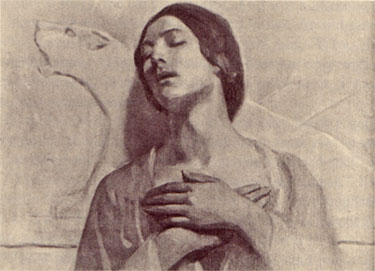
Kamilah, Kahlil's mother. Painting by Kahlil Gibran
On Joy and Sorrow
Your joy is your sorrow unmasked.
And the selfsame well from which your laughter rises was oftentimes filled with your tears.
And how else can it be?
The deeper that sorrow carves into your being, the more joy you can contain.
Is not the cup that holds your wine the very cup that was burned in the potter’s oven?
And is not the lute that soothes your spirit, the very wood that was hollowed with knives?
When you are joyous, look deep into your heart and you shall find it is only that which has given you sorrow that is giving you joy.
When you are sorrowful look again in your heart, and you shall see that in truth you are weeping for that which has been your delight.
Some of you say, “Joy is greater thar sorrow,” and others say, “Nay, sorrow is the greater.”
But I say unto you, they are inseparable.
Together they come, and when one sits, alone with you at your board, remember that the other is asleep upon your bed.
Verily you are suspended like scales between your sorrow and your joy.
Only when you are empty are you at standstill and balanced.
When the treasure-keeper lifts you to weigh his gold and his silver, needs must your joy or your sorrow rise or fall.
Kahlil Gibran

Saturday, February 12, 2011

Opening to the Present Moment

Mary Maddux of Meditation Oasis wrote a beautiful post on her blog last year on how meditation brings us to an awareness of being fully alive to the present moment. I shared her post previously on JBBC, but today re-reading it, I was struck once more by what a helpful reminder her words are to us and want to share it here again.
Being alive is fulfilling in and of itself when we open more to what is happening in the “present moment”. But opening to the present moment isn’t just about “smelling the roses”, it’s also about the willingness to feel pain.
In our culture, we try to avoid feeling pain. Whether the pain is physical or emotional, we’ll do anything to not feel it, from popping pills to distracting ourselves by keeping busy. And yet, when we repress or avoid feeling something, we restrict the flow of life energy. Our awareness becomes restricted and our capacity to feel is dulled. We can’t be fully alive without experiencing it all — pleasure and pain, joy and sorrow. The same meditative path that has allowed me to derive so much satisfaction from the small pleasures of life has required that I also feel pain more acutely.
How does meditation create such a shift in experience? How can it help us feel more fully alive?
Meditation involves what we do with our attention. So often our attention is caught up in thoughts, so that we miss the experiences coming through our senses. Most meditation styles encourage letting go of thoughts and shifting the attention to the breath or the body or to simply experiencing the ongoing succession of experiences that occur from moment to moment. Thus we develop the habit of letting go of thoughts and paying attention to the sensation of breathing, bodily sensations, emotions, sensory input.
Meditation also involves letting go of the attempt to manipulate our experience. We let go of resistance to what is and stop trying to change what we think and feel.
Just a few minutes ago I was making the bed. My mind was caught up in writing this blog post and then there was a shift. My attention came back to the bed making. No longer caught up in thoughts, I was seeing the color of the sheets, feeling their texture in my hands, hearing the rustling sound as I pulled the pillowcase over the pillow. Thanks to writing this post, I noticed the satisfaction inherent in this simple experience. Meditation can also encourage us to accept the ever-changing flow of emotions.
As I made the bed, there were a number of feelings present. Not resisting certain feelings or trying to make myself feel otherwise left my attention undivided. This too contributed to being fully present to the experience of making the bed. Meditation can free our attention from preoccupation with thoughts of past and future or of how we think things should be. The attention, left free, naturally experiences what is happening moment to moment."
http://beyondbreastcancer.wordpress.com/2011/02/12/opening-to-the-present-moment/

Friday, February 11, 2011

Poetry Friday from Journeying Beyond Breast Cancer


The Sound of Thankfulness

Classical guitar
playing
under the lakeside stars
harmonising
with gentle evening birdsong.

The sounds of water
lapping
as the sun creeps over the horizon
harmonising
with chatty sunrise birdsong.

Blessings
truly
simply
counted.

Today’s poem is from the pen of Feisty Blue Gecko

Tuesday, December 14, 2010

NO LEFT TURNS ... WISDOM FOR LIFE

This is a story of an aging couple, told by their son who was President of NBC NEWS.

This is a wonderful piece by Michael Gartner, editor of newspapers large and small and president of NBC News. In 1997, he won the Pulitzer Prize for editorial writing It is well worth reading, and a few good chuckles are guaranteed. Here goes...


My father never drove a car. Well, that's not quite right. I should say I never saw him drive a car.

He quit driving in 1927, when he was 25 years old, and the last car he drove was a 1926 Whippet.

"In those days," he told me when he was in his 90s, "to drive a car you had to do things with your hands, and do things with your feet, and look every which way, and I decided you could walk through life and enjoy it or drive through life and miss it."

At which point my mother, a sometimes salty Irishwoman, chimed in: "Oh, bull shit!" she said. "He hit a horse."

"Well," my father said, "there was that, too."

So my brother and I grew up in a household without a car. The neighbors all had cars -- the Kollingses next door had a green 1941Dodge, the VanLaninghams across the street a gray 1936 Plymouth, the Hopsons two doors down a black 1941 Ford -- but we had none.

My father, a newspaperman in Des Moines , would take the streetcar to work and, often as not, walk the 3 miles home If he took the streetcar home, my mother and brother and I would walk the three blocks to the streetcar stop, meet him and walk home together.

My brother, David, was born in 1935, and I was born in 1938, and sometimes, at dinner, we'd ask how come all the neighbors had cars but we had none. "No one in the family drives," my mother would explain, and that was that.

But, sometimes, my father would say, "But as soon as one of you boys turns 16, we'll get one." It was as if he wasn't sure which one of us would turn 16 first.

But, sure enough , my brother turned 16 before I did, so in 1951 my parents bought a used 1950 Chevrolet from a friend who ran the parts department at a Chevy dealership downtown.

It was a four-door, white model, stick shift, fender skirts, loaded with everything, and, since my parents didn't drive, it more or less became my brother's car.

Having a car but not being able to drive didn't bother my father, but it didn't make sense to my mother.

So in 1952, when she was 43 years old, she asked a friend to teach her to drive. She learned in a nearby cemetery, the place where I learned to drive the following year and where, a generation later, I took my two sons to practice driving. The cemetery probably was my father's idea. "Who can your mother hurt in the cemetery?" I remember him saying more than once.

For the next 45 years or so, until she was 90, my mother was the driver in the family. Neither she nor my father had any sense of direction, but he loaded up on maps -- though they seldom left the city limits -- and appointed himself navigator. It seemed to work.

Still, they both continued to walk a lot. My mother was a devout Catholic, and my father an equally devout agnostic, an arrangement that didn't seem to bother either of them through their 75 years of marriage.

(Yes, 75 years, and they were deeply in love the entire time.)

He retired when he was 70, and nearly every morning for the next 20 years or so, he would walk with her the mile to St. Augustin's Church. She would walk down and sit in the front pew, and he would wait in the back until he saw which of the parish's two priests was on duty that morning. If it was the pastor, my father then would go out and take a 2-mile walk, meeting my mother at the end of the service and walking her home.

If it was the assistant pastor, he'd take just a 1-mile walk and then head back to the church. He called the priests "Father Fast" and "Father Slow."

After he retired, my father almost always accompanied my mother whenever she drove anywhere, even if he had no reason to go along. If she were going to the beauty parlor, he'd sit in the car and read, or go take a stroll or, if it was summer, have her keep the engine running so he could listen to the Cubs game on the radio. In the evening, then, when I'd stop by, he'd explain: "The Cubs lost again. The millionaire on second base made a bad throw to the millionaire on first base, so the multimillionaire on third base scored."

If she were going to the grocery store, he would go along to carry the bags out -- and to make sure she loaded up on ice cream. As I said, he was always the navigator, and once, when he was 95 and she was 88 and still driving, he said to me, "Do you want to know the secret of a long life?"

"I guess so," I said, knowing it probably would be something bizarre.

"No left turns," he said.

"What?" I asked.

"No left turns," he repeated. "Several years ago, your mother and I read an article that said most accidents that old people are in happen when they turn left in front of oncoming traffic.

As you get older, your eyesight worsens, and you can lose your depth perception, it said. So your mother and I decided never again to make a left turn."

"What?" I said again.

"No left turns," he said. "Think about it. Three rights are the same as a left, and that's a lot safer. So we always make three rights."

"You're kidding!" I said, and I turned to my mother for support. "No," she said, "your father is right. We make three rights. It works." But then she added: "Except when your father loses count."

I was driving at the time, and I almost drove off the road as I started laughing.

"Loses count?" I asked.

"Yes," my father admitted, "that sometimes happens. But it's not a problem. You just make seven rights, and you're okay again."

I couldn't resist. "Do you ever go for 11?" I asked.

"No," he said " If we miss it at seven, we just come home and call it a bad day. Besides, nothing in life is so important it can't be put off another day or another week." My mother was never in an accident, but one evening she handed me her car keys and said she had decided to quit driving. That was in 1999, when she was 90.

She lived four more years, until 2003. My father died the next year, at
102.

They both died in the bungalow they had moved into in 1937 and bought a few years later for $3,000. (Sixty years later, my brother and I paid $8,000 to have a shower put in the tiny bathroom -- the house had never had one. My father would have died then and there if he knew the shower cost nearly three times what he paid for the house.)

He continued to walk daily -- he had me get him a treadmill when he was 101 because he was afraid he'd fall on the icy sidewalks but wanted to keep exercising -- and he was of sound mind and sound body until the moment he died

One September afternoon in 2004, he and my son went with me when I had to give a talk in a neighboring town, and it was clear to all three of us that he was wearing out, though we had the usual wide-ranging conversation about politics and newspapers and things in the news.

A few weeks earlier, he had told my son, "You know, Mike, the first hundred years are a lot easier than the second hundred." At one point in our drive that Saturday, he said, "You know, I'm probably not going to live much longer."

"You're probably right," I said.

"Why would you say that?" He countered, somewhat irritated.

"Because you're 102 years old," I said..

"Yes," he said, "you're right." He stayed in bed all the next day.

That night, I suggested to my son and daughter that we sit up with him through the night.

He appreciated it, he said, though at one point, apparently seeing us look gloomy, he said: "I would like to make an announcement. No one in this room is dead yet"

An hour or so later, he spoke his last words:

"I want you to know," he said, clearly and lucidly, "that I am in no pain. I am very comfortable. A nd I have had as happy a life as anyone on this earth could ever have."

A short time later, he died.

I miss him a lot, and I think about him a lot. I've wondered now and then how it was that my family and I were so lucky that he lived so long.

I can't figure out if it was because he walked through life, Or because he quit taking left turns. "

Life is too short to wake up with regrets.

So love the people who treat you right.

Forget about the one's who don't.

Believe everything happens for a reason.

If you get a chance, take it & if it changes your life, let it.

Nobody said life would be easy, they just promised it would most likely be worth it."

ENJOY LIFE NOW - IT HAS AN EXPIRATION DATE!

Tuesday, August 3, 2010

Rave Review for Susan's from Chemotherapy Client

We had a wonderful compliment this morning. One of our clients was at her oncologist and told her that she should send all of her patients to Susan's.  She always felt comfortable, everyone was so friendly and she only had to go to one place to find products for her new needs. It's nice to hear and we are always working hard to make sure all of our clients needs are met. It is our passion to help women with their new needs and discover their new norm. Women tell us they feel like themselves again.  800.497.7005  www.SusansSpecialNeeds.com

Tuesday, July 27, 2010

Breast Cancer Fashion Bracelets

Just got these cute breast cancer fashion bracelets in.  They look great and support the cause. 800.497.7005  www.SusansSpecialNeeds.com

Tuesday, February 9, 2010

Thoughts for a snowy afternoon

Just thinking as we are watching tons of snow coming down here in Michigan. We are grateful that we do not have 30 inches on the ground and are thinking of all of our friends and families elsewhere who are dealing with these unusual weather conditions. We pray for their safety and for quick resolution to easing their discomfort. I am thinking how different we are in talking and presenting information to our clients. They are just not the next number. We acknowledge them emotionally and try our best to reach out, to reassure, to educate and to serve their special needs. I appreciate the opprtunity to serve and pledge to all of you out there our continued passsion to be the best in the business and to listen and thus to guide. These are difficult times and knowing we are here ready to help. The fire going, the coffee is brewing....talk to us, we are listening, we are here.